
Treating Diabetes Without Medication
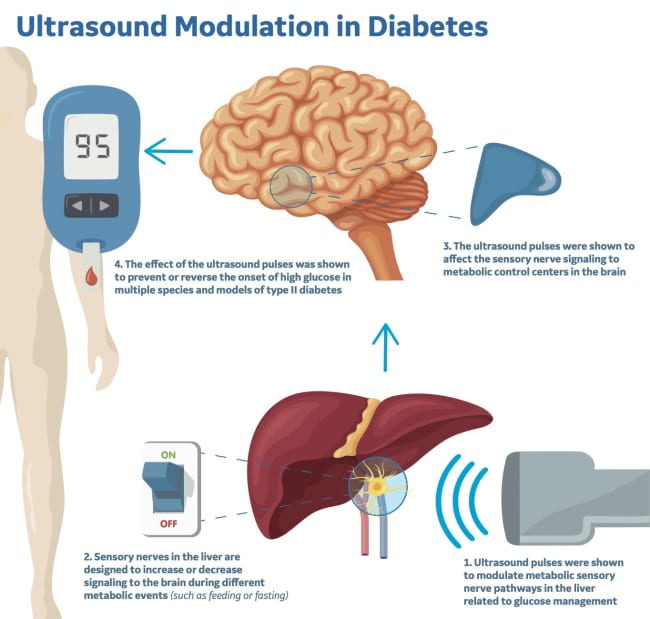
In three different preclinical models, a multi-institutional team led by Yale School of Medicine (YSM) demonstrated the ability to use ultrasound to stimulate specific neurometabolic pathways in the body treating diabetes without medication and to prevent or reverse the onset of type 2 diabetes. The findings were published in Nature Biomedical Engineering by the team, which included Raimund Herzog's, MD, MHS, lab at YSM.
The researchers are now conducting human feasibility trials with type 2 diabetic subjects, bringing medicine one step closer to the day when diabetes will no longer be monitored and managed with blood sugar tests, insulin injections, and drug treatments.
The studies' goal is to find a long-term treatment for type 2 diabetes that will alleviate and possibly reverse the disease.
Millions of people worldwide suffer from type 2 diabetes. The long-term condition causes an excess of sugar to circulate in the bloodstream. Diabetes is a leading cause of blindness, kidney failure, heart attacks, stroke, and amputation of lower limbs.
Herzog, an associate professor (endocrinology) in the Department of Internal Medicine at YSM and a member of the NIH-funded Yale Diabetes Research Center, and his colleagues put the findings to the test The magnitude of the effect of ultrasound therapy on blood glucose levels.
"Even though we have a wide range of anti-diabetic medications to treat high glucose levels, we are always looking for new ways to improve insulin sensitivity in diabetes," Herzog said.
"Unfortunately, there are currently only a few drugs available that lower insulin levels," Herzog added. "If our ongoing clinical trials confirm the promise of the preclinical studies reported in this paper, and ultrasound can be used to lower both insulin and glucose levels, ultrasound neuromodulation would represent an exciting and completely novel addition to our patients' current treatment options."
The findings are a significant step forward in the field of bioelectronic medicine, which is looking into new ways to treat chronic diseases like diabetes by using novel medical devices to modulate the body's nervous system.
GE Research has been working on a novel, non-invasive stimulation technique that uses ultrasound to stimulate specific neural pathways within organs associated with disease for the past six years.
Following the reported preclinical studies, the collaborators have been involved in additional studies to investigate the effects of alternative dosing, such as the type of ultrasound pulse and treatment duration. The team is expected to release findings from those studies later this year.
YSM is part of a team led by GE Research that also includes the Feinstein Institutes for Medical Research Albany Medical College and UCLA's Samueli School of Engineering
Diabetes research reported in Nature Biomedical Engineering was funded in part by the Defense Advanced Research Projects Agency's Biological Technologies Office (BTO) (DARPA).
The Section of Endocrinology and Metabolism at Yale University works to improve the health of people with endocrine and metabolic diseases by advancing scientific knowledge, applying new information to patient care, and training the next generation of physicians and scientists to be leaders in the field.

No comments:
Post a Comment